Have you ever wondered what your voice actually sounds like to other people? Not the version you hear in your head, but the real thing — the one that comes through on a recording, a phone call, or a livestream.
Most of us go through life never really evaluating our voice. We notice it only when something feels off: a scratchy throat after a long lecture, a shaky note during a song, or feedback that our podcast sounds “flat.” That’s where the idea of Rate My Voice comes in.
Rate My Voice is more than a catchy phrase. It represents a growing interest in AI voice analysis — using technology to measure, score, and understand the acoustic qualities of a human voice. Instead of guessing, you get data. Instead of vague feedback like “sounds nice” or “a bit rough,” you get real numbers rooted in clinical acoustic science.
This article walks you through what it means to rate your voice, how AI makes this possible, and how My Voice Score, a free online voice analysis platform, turns complex acoustic science into a simple, easy-to-read voice score anyone can understand.
What Does “Rate My Voice” Mean?
At its core, “rate my voice” means evaluating the quality, health, and performance characteristics of your speaking or singing voice using objective measurements rather than personal opinion.
When people search for rate my voice online, they’re usually looking for one of a few things:
- A way to check their vocal health
- Feedback on singing or speaking performance
- Confirmation that their voice sounds clear and professional
- A tool to track improvement over time
Traditionally, this kind of feedback came from voice coaches, speech-language pathologists, or singing teachers. Today, an online voice analyzer can provide a first layer of insight instantly, using the same acoustic principles that professionals rely on in clinical and training settings.
Why Should You Rate Your Voice?
Your voice is one of your most-used communication tools, yet it’s also one of the most overlooked. Rating your voice isn’t about vanity — it’s about awareness.
Here’s why people choose to analyze their voice:
- Professional communication. Clear, confident vocal delivery affects how people perceive your credibility.
- Vocal health monitoring. Subtle changes in your voice can be an early sign of strain or fatigue.
- Performance improvement. Singers and speakers benefit from measurable feedback rather than guesswork.
- Career growth. Podcasters, voice actors, and sales professionals depend on vocal clarity to succeed.
- Progress tracking. Voice training only works if you can measure change over time.
A voice quality analysis gives you a baseline. Once you know where you stand, you can set realistic goals and track real progress
How AI Can Rate Your Voice
Artificial intelligence has transformed how voice is studied. In the past, acoustic analysis required expensive lab equipment and a trained technician. Now, AI voice analysis tools can process a simple audio recording and extract meaningful acoustic data in seconds.
AI contributes to voice rating in three major ways:
- Transcription. AI models convert speech into text, which helps measure speech rate, articulation, and word patterns.
- Voice activity detection. AI identifies which parts of a recording contain actual speech versus silence or background noise.
- Acoustic measurement. Signal-processing algorithms calculate scientific voice parameters like pitch stability, noise levels, and vocal clarity.
Combined, these technologies allow a voice rating tool to generate a comprehensive, objective voice score without requiring a clinical visit.
How My Voice Score Works
My Voice Score was built to make professional-grade speech analysis accessible to everyone. The process is simple on the surface, but it’s powered by clinically informed acoustic science underneath.
Record Voice
You start by recording a short sample of your speaking or singing voice directly through your browser. No downloads or special microphones are required, though a quiet environment improves accuracy.
AI Speech Transcription
Once recorded, the audio is transcribed using Whisper AI, an automatic speech recognition system. This step captures what was said and helps calculate speech rate and articulation patterns.
Voice Activity Detection
Next, the platform applies Silero VAD, a voice activity detection model that identifies the exact segments of your recording that contain speech. This separates actual vocal content from silence, background noise, or pauses, ensuring the analysis focuses only on your voice.
Acoustic Analysis Using Praat
The core of the system relies on Praat, a widely respected acoustic analysis software used in linguistics and voice science research for decades. Praat extracts detailed vocal fold and resonance measurements, forming the scientific backbone of your results.
Generate Voice Score
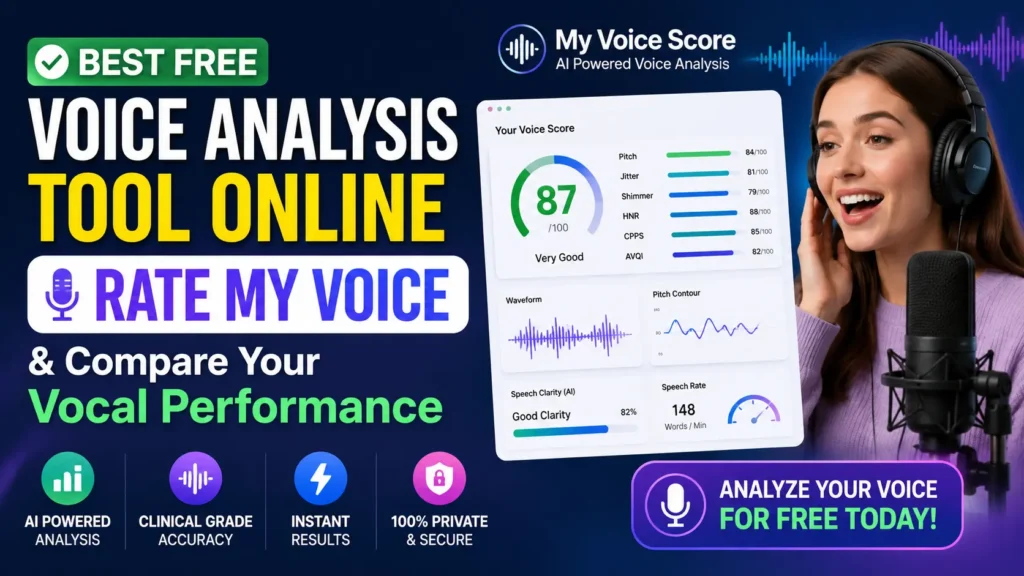
Finally, all the extracted data — pitch, stability, noise ratios, and speech patterns — is combined into an overall voice score. This score is presented in a simple, visual format so you don’t need a science background to understand your results.
Note: My Voice Score is an educational and screening tool only. It is not a medical device and does not diagnose voice disorders.
Understanding Your Voice Score
Your voice score is built from several acoustic metrics, each reflecting a different aspect of vocal performance. Here’s what they mean in plain language.
Pitch
Pitch refers to how high or low your voice sounds, measured in Hertz (Hz). It reflects the frequency at which your vocal folds vibrate. Consistent, controlled pitch is important for both singing accuracy and natural-sounding speech.
Jitter
Jitter measures the tiny, cycle-to-cycle variations in your vocal pitch. A small amount of jitter is normal, but higher levels can indicate vocal instability or strain, since the vocal folds aren’t vibrating with consistent timing.
Shimmer
Shimmer is similar to jitter, but it measures variations in loudness rather than pitch. Elevated shimmer can suggest breathiness or reduced control over vocal fold closure.
Harmonics-to-Noise Ratio (HNR)
HNR compares the harmonic (clear, musical) part of your voice to the noise (breathy, airy) part. A higher HNR generally means a clearer, more resonant voice, while a lower HNR can indicate hoarseness or breathiness.
Cepstral Peak Prominence (CPPS)
CPPS is considered one of the most reliable indicators of overall voice quality in acoustic research. It measures how prominent the strongest harmonic peak is within your voice signal, which correlates strongly with perceived vocal clarity.
Acoustic Voice Quality Index (AVQI)
The AVQI combines multiple acoustic measurements into a single composite index. It’s widely used in voice science as a shorthand summary of overall vocal quality, blending metrics like HNR, shimmer, and spectral characteristics.
Speech Rate
Speech rate measures how quickly you speak, typically in words per minute. Speaking too fast can reduce clarity, while speaking too slowly can affect engagement — especially important for public speakers and podcasters.
Pause Analysis
This metric looks at the frequency and length of pauses in your speech. Well-placed pauses improve comprehension and pacing, while excessive or awkward pauses can disrupt the flow of your message.
Who Can Benefit From Voice Analysis?
Voice analysis isn’t just for singers or medical patients. It’s useful across a wide range of professions and personal goals.
- Singers — Track pitch accuracy and vocal stability over time.
- Teachers — Maintain vocal health during long hours of daily speaking.
- Public Speakers — Improve clarity, pacing, and confidence.
- Podcasters — Ensure consistent, professional-sounding audio.
- Voice Actors — Fine-tune vocal quality and expressiveness.
- Sales Professionals — Build trust through clear, confident delivery.
- Customer Support Teams — Maintain a calm, clear tone during calls.
- Speech-Language Pathologists — Use objective data alongside clinical judgment.
- Voice Therapists — Monitor client progress with measurable metrics.
- Students — Improve presentation skills and vocal confidence.
Benefits of AI Voice Analysis
Using an online voice analyzer offers several practical advantages over relying on self-perception alone:
- Objective feedback instead of subjective opinions
- Instant results without scheduling a clinical appointment
- Progress tracking across multiple recordings
- Accessibility from any device with a browser
- Cost savings compared to specialized lab equipment
- Awareness of vocal habits you may not notice on your own
While AI tools are not a replacement for professional clinical evaluation, they offer a valuable starting point for anyone curious about their vocal performance.
How to Improve Your Voice Score
Improving your voice score comes down to consistent, healthy vocal habits combined with regular practice.
- Stay hydrated. Vocal folds function best when properly lubricated.
- Warm up before speaking or singing extensively.
- Avoid vocal strain, such as shouting or speaking over loud background noise.
- Practice breath support to reduce shimmer and jitter caused by inconsistent airflow.
- Record yourself regularly to track changes over time.
- Rest your voice when you notice fatigue or hoarseness.
- Seek professional guidance if you notice persistent vocal changes.
Small, consistent improvements in vocal habits often lead to measurable changes in your voice score analysis over time.
Why Choose My Voice Score?
My Voice Score stands out as a free voice analysis tool because it combines clinically grounded acoustic science with an easy-to-understand interface.
- Built on Praat, a trusted standard in acoustic voice research
- Uses Whisper AI for accurate speech transcription
- Applies Silero VAD for precise voice activity detection
- Presents complex data — pitch, jitter, shimmer, HNR, CPPS, and AVQI — in a simple, visual score
- Free and accessible directly from your browser
- Designed for singers, speakers, educators, and voice professionals alike
Unlike generic audio tools, My Voice Score focuses specifically on the acoustic metrics that voice scientists and clinicians use, translated into language everyday users can actually understand.
My Voice Score vs Traditional Voice Assessment
| Feature | My Voice Score (AI Tool) | Traditional Clinical Assessment |
|---|---|---|
| Cost | Free | Often expensive |
| Accessibility | Instant, online, any device | Requires appointment |
| Turnaround time | Seconds | Days to weeks |
| Core technology | Praat, Whisper AI, Silero VAD | Specialized lab equipment |
| Best for | Screening, tracking, self-improvement | Diagnosis and treatment planning |
| Medical diagnosis | Not provided | Provided by licensed professionals |
| Convenience | High | Moderate to low |
Important: My Voice Score is designed for education and self-screening. For any diagnosis or treatment of a voice disorder, always consult a licensed speech-language pathologist or ENT specialist.
Frequently Asked Questions
1. Is My Voice Score really free?
Yes. My Voice Score offers a free online voice analyzer so anyone can check their vocal performance without cost.
2. Can this tool diagnose a voice disorder?
No. My Voice Score is an educational and screening tool only. It does not diagnose medical conditions. Consult a licensed professional for medical concerns.
3. What is a normal jitter or shimmer value?
Normal ranges vary by individual voice type and recording conditions. Your results should be viewed as a general guide, not a fixed clinical standard.
4. How accurate is AI voice analysis?
The platform uses established acoustic science tools like Praat, combined with AI models such as Whisper and Silero VAD, to provide reliable estimates under good recording conditions.
5. Do I need special equipment to record my voice?
No. A standard smartphone or computer microphone works well, though a quiet room improves accuracy.
6. Can singers use this tool?
Yes. Singers often use voice analysis to track pitch stability, vocal clarity, and overall performance over time.
7. How often should I check my voice score?
Many users check weekly or biweekly to monitor progress, especially when actively working on vocal training.
8. What does CPPS measure?
CPPS reflects the clarity of your voice by measuring the strength of the dominant harmonic peak, making it a strong indicator of overall vocal quality.
9. Is this tool suitable for public speakers and podcasters?
Yes. Public speakers and podcasters often use voice scoring to refine pacing, clarity, and vocal presence.
10. Where can I learn more about individual metrics?
You can explore dedicated guides for each metric, including Pitch, Jitter, Shimmer, HNR, CPPS, and AVQI.
Conclusion
Understanding your voice doesn’t require guesswork anymore. With AI voice analysis, anyone can access clinically informed insights into pitch, clarity, stability, and overall vocal quality — all from a simple recording.
Whether you’re a singer refining your technique, a public speaker building confidence, or simply curious about your vocal health, tools like My Voice Score make voice assessment accessible, fast, and free.
Ready to see how your voice measures up? Record your voice with My Voice Score today and get your personalized voice score in seconds.
Medical Disclaimer
My Voice Score is an educational and self-screening tool designed to provide general information about vocal acoustic characteristics. It is not a medical device and does not diagnose, treat, cure, or prevent any medical condition or voice disorder. Results are for informational purposes only and should not replace professional medical advice. If you are experiencing persistent voice changes, pain, or discomfort, please consult a licensed physician, otolaryngologist (ENT), or speech-language pathologist.